Sometimes a rooster just shows up in your sketchbook. No warning. No grand plan. A few strokes of the pen, and suddenly there’s a chicken staring back at you—oddly mythical and proudly Ukrainian.
That’s how Der Baukasten began.
Arthur Avakyan, our in-house illustrator and graphic designer, came up with the idea. No one asked him to do it. He didn’t pitch it. It just… happened. Like most things worth building.
Tubik Lab: The Playground Where it All Started
Tubik Studio has its own digital gallery, where we showcase ideas made not for clients, but for the sake of creating. We call it Tubik Lab—our little corner for experiments. It’s a petri dish for offbeat ideas, forgotten side projects, and designs that don’t need to prove anything. That’s where Der Baukasten was born.
What started as a one-character experiment got shared in our internal sketch rounds. Then, it grew some wings. Then, a tail. Then, it galloped away with us.
We weren’t chasing client KPIs. We were chasing attention—and yeah, maybe a few shiny awards along the way. (Spoiler: it worked. Der Baukasten took home FWA of the Day, Awwwards Site of the Day, and GSAP’s Site of the Week.)
But that was never the goal. The goal was the itch. And scratching it.
From Rooster to Roaming Creatures
Every Wednesday, our design crew meets to show what we’ve been doodling. Arthur showed the rooster sketch, plus a bit of lettering—a wink to vintage Ukrainian lithograph fonts. The kind you’d find on an old candy wrapper or a dusty fairytale book.
The team loved it. It looked like something you could print, hold, rotate in your hand. Packaging? Maybe. Toy? Closer. A constructible, magnetic toy? Why not.
So we pushed it. Expanded the world. Arthur added two more creatures—the Stork and the Horse. Together they formed a trio: grounded in Ukrainian folklore but built with modern lines and color logic. Not nostalgic, not decorative—alive. Ready to be taken apart, reassembled, turned into something else.
Design That Clicks (Literally)
The project was now clearly modular—and that was our pivot point. We leaned into the physicality. Made it a toy concept first, then built the entire design system around that idea.
Sergii Valiukh, Tubik’s founder, picked up the thread in Blender. Each creature was made up of hundreds of parts—think of them like Lego pieces, but less forgiving. Around 300 separate modules, all needing to slot into the right place at the right time without bumping into each other mid-animation.
Every part had a “zero point”—a kind of anchor in space. That’s what allowed Sergii to animate the transformation from Rooster to Stork to Horse in a way that felt intentional, not chaotic. Like origami folding itself into something new.
He rigged the whole thing with Blender’s EEVEE render engine, carefully matching the lighting and materials so that when it landed in three.JS on the site, the developers wouldn’t have to do a full visual overhaul. No “we’ll fix it in dev” shortcuts. We made it look good inside Blender first—then passed it along with all the right settings baked in.
Motion Magic
While that was happening, Ernest Asanov, our Art Director, started thinking about motion. About how the UI could echo the toy’s build-it-yourself logic. No traditional layout grids. No scroll-and-forget blocks. His idea was to turn the scroll into an assembly line—literally. You scroll, the creature builds. Piece by piece. Motion meets structure. No loading bars, no popups. Just the soft satisfaction of watching something come together.
Ernest started with a draft—Sergii had already roughed out the 3D motion logic, and Arthur had created custom typography for each character. But the visuals weren’t quite clicking. The original blue background color was too soft, too polite. It didn’t play well with the bright 3D elements. So Ernest made the first cut: switched the stage to pitch black.
Suddenly, our creatures were glowing. Primary colors popped like Bauhaus interiors. That’s when the name landed, too: Der Baukasten. A German nod to “construction kit,” with a wink to modularity, folklore, and design history all at once.
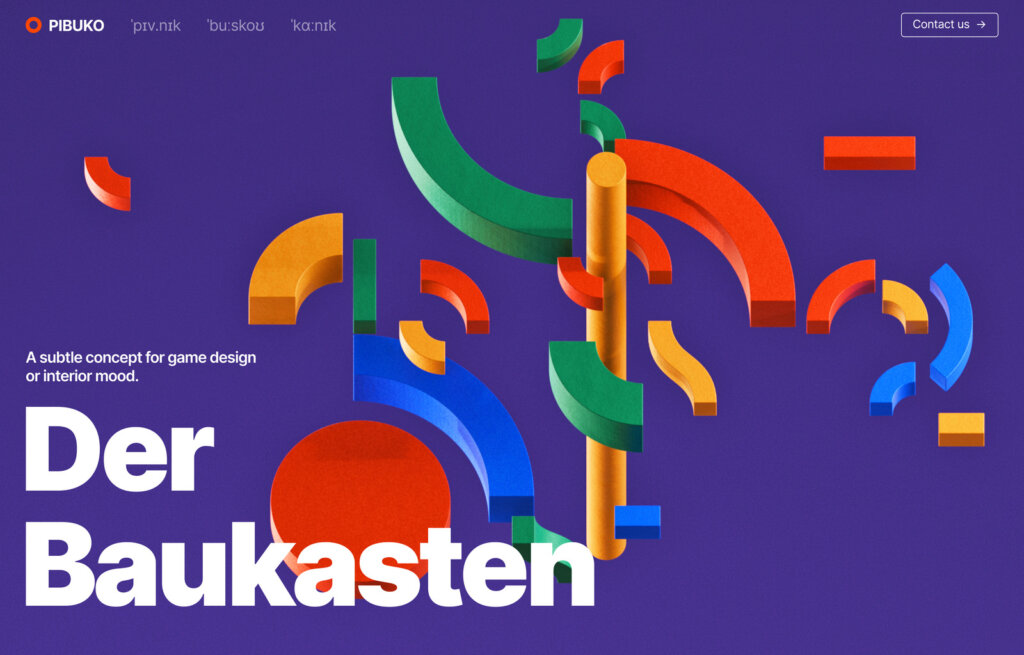
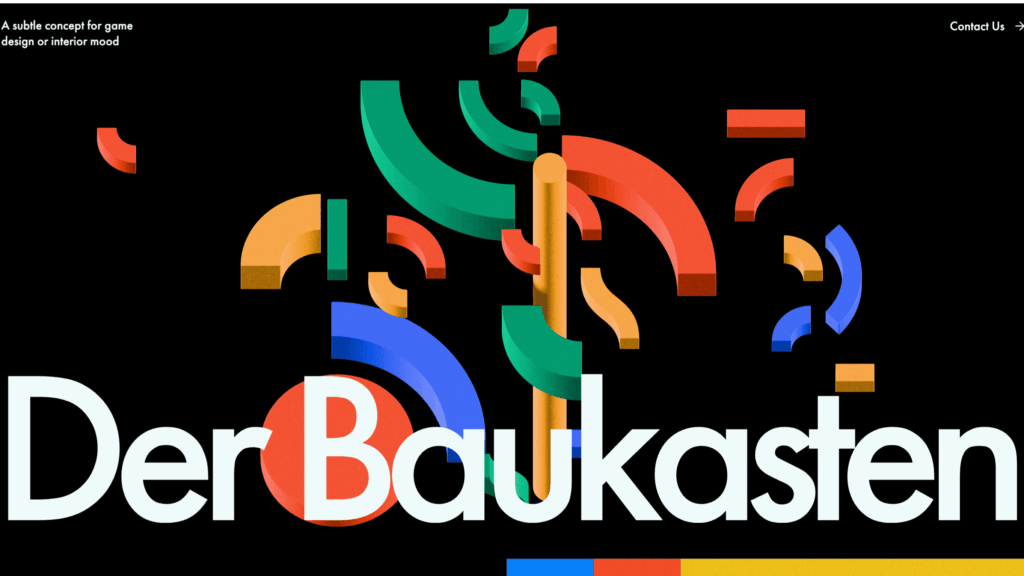
Then came the type. Arthur’s custom font was beautiful—handcrafted, full of personality. But in context, it was stealing too much of the show. So Ernest went full Bauhaus and swapped it for Futura: a nod to clean geometry, modularity, and a century’s worth of modernist conviction.
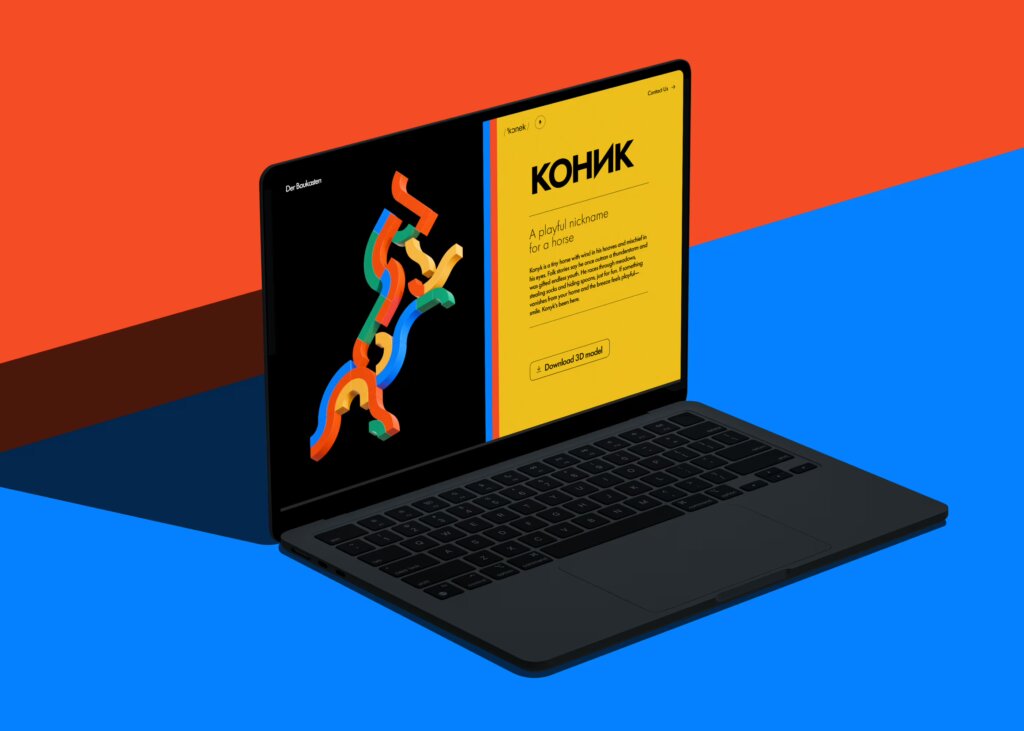
Next came the layout. A basic chessboard grid felt too rigid, too familiar. And against the black background, blank spaces turned into voids. We needed a way to structure the content without killing the vibe. That’s where the cards came in. Color-blocked, slightly overlapping, and stacked like an archival file drawer—they solved two problems at once: gave structure to the black space and opened up new ways to interact. You don’t scroll through this thing like a blog. You shuffle it. Tap it. Flip it open.
Each tap reveals something new: the creature’s name, how to pronounce it, and a downloadable file to 3D print it if you want to create your own physical version of those models. In its final version, the whole thing feels somewhere between an illustrated folklore deck and a designer’s personal filing cabinet—color-coded, slightly chaotic, oddly satisfying.
What Comes After the Rooster
Der Baukasten wasn’t designed to sit still. Not on the screen. Not in our heads.
It’s proof that something strange, beautiful, and technical can come out of nothing but time, curiosity, and a bit of mid-week sketching. This is the kind of project that reminds us why we have Tubik Lab in the first place—not to polish ideas for the pitch deck, but to break them. Stretch them. Build them from magnetic limbs and forgotten folklore until they start breathing on their own.
Some of our Lab pieces stay sketches. Some go on to win Awwwards and get picked apart by dev forums. This one did both. And it’s not the end of the story. We’re already working on the next build—louder colors, stranger logic. Maybe fewer roosters, maybe more, who knows?
What we’ve shared here is the visible part—the spark, the shape, the scroll. But underneath, there’s a whole other kind of story. One with Blender files that wouldn’t open. Scroll animations that refuse to move. That side of the process—the dev side—isn’t any less creative. It’s just messier. And we’ll get into that soon.
Because behind every smooth animation is a stack of glitches, experiments, and weirdly satisfying workarounds. And if the design was born from a sketch, the build came from pure stubbornness.
But that’s another story.
For now, it’s simple:
This one started with a rooster.
Who knows what hatches next.
Curious What Else We’re Up To?
Explore more Tubik case studies where sketches turn into systems, and ideas turn into award-winning projects:
Case Study: Daughter of the Inner Stars. Character Art and Logo Design for Performance
Case Study: Ammons’ Poetry. Creating Website About Poet’s Legacy
Case Study: 1260. Wine Brand Packaging Design with Medieval Vibes
Case Study: Advocacy Through Walls. Website Creation for Advocacy Guide
Case Study: Serra. Identity and Product Design for Financial App